---
title: "Cars and Animals"
subtitle: "Essay section 2: is the famous cat-and-car neuron a V-shape neuron? A direct check on the original weights"
---
The essay's first piece of evidence is a reinterpretation of the most famous polysemantic
neuron in the field, InceptionV1's **4e:55** (channel 55 of layer `mixed4e`). *Zoom In* (2020)
presented it as responding to cat faces and car fronts and said outright that it "isn't
responding to some commonality of cars and cat faces". The essay now says it is a **V-shape**
neuron: pointed things drive it positive, round things drive it negative, and the cats and cars
are two of many things with a V in them.
The original 2014 InceptionV1 weights are public (the `inception5h` graph that the Lucid and
Lucent libraries ship), so this is a claim we can check directly. We do not have ImageNet, so
we use the 5,000 COCO validation images instead, which have cats, cars, dogs and much else, and
which come with object labels we can use for statistics.
## What the essay claims, specifically
1. The neuron's strongest inputs from the previous layer include 4d:493 (fox snout),
4d:477 (wolf face) and 4d:201 (van front); its strongest reader downstream is 5a:94
(V-shaped flames).
2. Its negative pole is "an O, round where the V is pointed".
3. Its positive pole generalises beyond cats and cars to anything pointed: fox faces, pool
tables, bullet trains.
4. Therefore the right description is a *shared pattern* (a verb, "pointed versus round"), not
a *list of nouns* (cats OR cars).
Claims 1 and 2 are checkable from the weights and from any photo collection. Claim 3 we can
check partially with COCO's labels. Claim 4 is an interpretation, and the last section
discusses how much the evidence supports it.
```{python}
#| code-summary: "Setup: load the original InceptionV1 and scan COCO (cached after the first run)"
import sys, pathlib, json, numpy as np, torch, matplotlib.pyplot as plt
from PIL import Image
ROOT = pathlib.Path.cwd().parent
sys.path.insert(0, str(ROOT))
from common.inception import load_inceptionv1, scan_layer, receptive_crop
plt.rcParams.update({"figure.dpi": 110, "font.size": 9})
DEV = "cuda" if torch.cuda.is_available() else "cpu"
CH = 55
model = load_inceptionv1(DEV)
paths = sorted((ROOT / "data/coco/val2017").glob("*.jpg"))
cache = ROOT / "data/cache/mixed4e_1x1_prerelu_coco.npz"
if cache.exists():
    z = dict(np.load(cache))
else:
    res = scan_layer(model, "mixed4e_1x1_pre_relu_conv", paths, device=DEV, batch=100)
    np.savez_compressed(cache, **{k: v for k, v in res.items() if k != "paths"}, paths=np.array(res["paths"]))
    z = dict(np.load(cache))
mx, mn, grid = z["max"][:, CH], z["min"][:, CH], int(z["grid"][0])
print(f"{len(paths)} images; 4e:55 pre-ReLU spatial max: median {np.median(mx):.0f}, "
      f"99th pct {np.percentile(mx, 99):.0f}, top {mx.max():.0f}; spatial min: bottom {mn.min():.0f}")
```
A note on what is measured. `mixed4e` is a concatenation of four branches and channel 55 is in
the 1×1 branch, so we hook that branch's convolution *before* its ReLU. That way the negative
pole is visible; after the ReLU it would be zero everywhere. For each image we record the
maximum and minimum over the 14×14 spatial grid and where they occur, and show a crop around
that location as a stand-in for the receptive field.
## The two poles on 5,000 photographs
```{python}
#| code-summary: "Contact sheets of the strongest positive and negative responses"
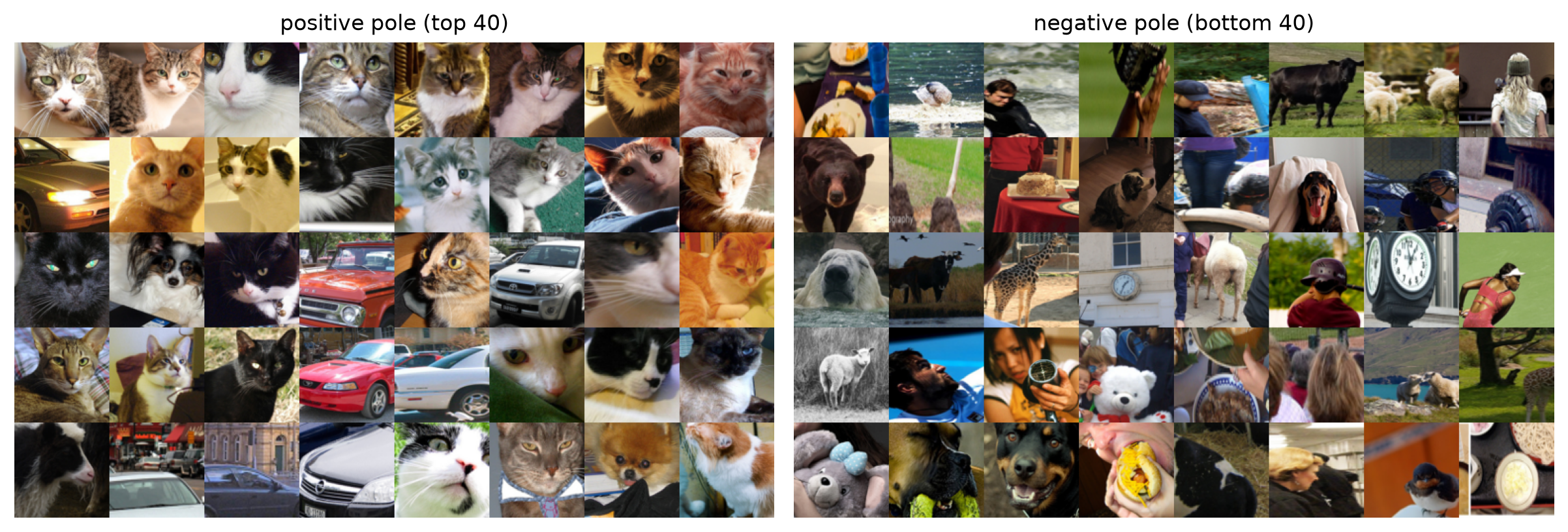
#| fig-cap: "Left: crops around the location of the 40 strongest positive responses of 4e:55 in COCO val2017. Right: the 40 strongest negative responses. Each crop is about 45% of the 224-pixel input, centred on the activation's location."
def sheet(order, locs, n=40, ncol=8, size=96):
    W = Image.new("RGB", (ncol*size, (n//ncol)*size), "white")
    for k, i in enumerate(order[:n]):
        c = receptive_crop(pathlib.Path(z["paths"][i]), locs[i, CH], grid).resize((size, size))
        W.paste(c, ((k % ncol)*size, (k//ncol)*size))
    return W
pos = sheet(np.argsort(-mx), z["argmax_yx"]); neg = sheet(np.argsort(mn), z["argmin_yx"])
fig, axes = plt.subplots(1, 2, figsize=(11, 3.8))
for ax, im, t in zip(axes, [pos, neg], ["positive pole (top 40)", "negative pole (bottom 40)"]):
    ax.imshow(im); ax.set_title(t); ax.axis("off")
plt.tight_layout()
```
The positive sheet is the famous grid: frontal cat faces and the fronts of cars, with a couple
of small dogs. The negative sheet is clocks, the round heads of bears and cows, teddy bears,
the backs of human heads, plates and bowls. The essay's description of the negative pole as
"an O" holds up on a dataset the neuron was never ranked on before.
## Is it really just cats and cars? Using the labels
COCO's instance annotations tell us what is in each image. If the neuron were an OR of cat
and car, images with neither should not reach the top. If it is a V-shape detector, some
should, and they should be pointed things.
```{python}
#| code-summary: "Label statistics of the top images"
ann = json.load(open(ROOT / "data/coco/annotations/instances_val2017.json"))
cat_name = {c["id"]: c["name"] for c in ann["categories"]}
labels = {}
for a in ann["annotations"]:
    labels.setdefault(a["image_id"], set()).add(cat_name[a["category_id"]])
ids = [int(pathlib.Path(p).stem) for p in z["paths"]]
def has(i, names): return bool(labels.get(ids[i], set()) & set(names))
order = np.argsort(-mx)
vehicles = ["car", "truck", "bus"]
print(f"{'top-k':>6s} {'cat':>6s} {'car/truck/bus':>14s} {'dog':>6s} {'none of these':>14s}")
for k in (20, 50, 200, 500):
    top = order[:k]
    print(f"{k:6d} {np.mean([has(i,['cat']) for i in top]):6.2f} "
          f"{np.mean([has(i,vehicles) for i in top]):14.2f} "
          f"{np.mean([has(i,['dog']) for i in top]):6.2f} "
          f"{np.mean([not has(i,['cat','dog']+vehicles) for i in top]):14.2f}")
```
```{python}
#| code-summary: "The strongest responses among images with no cat, dog, car, truck or bus"
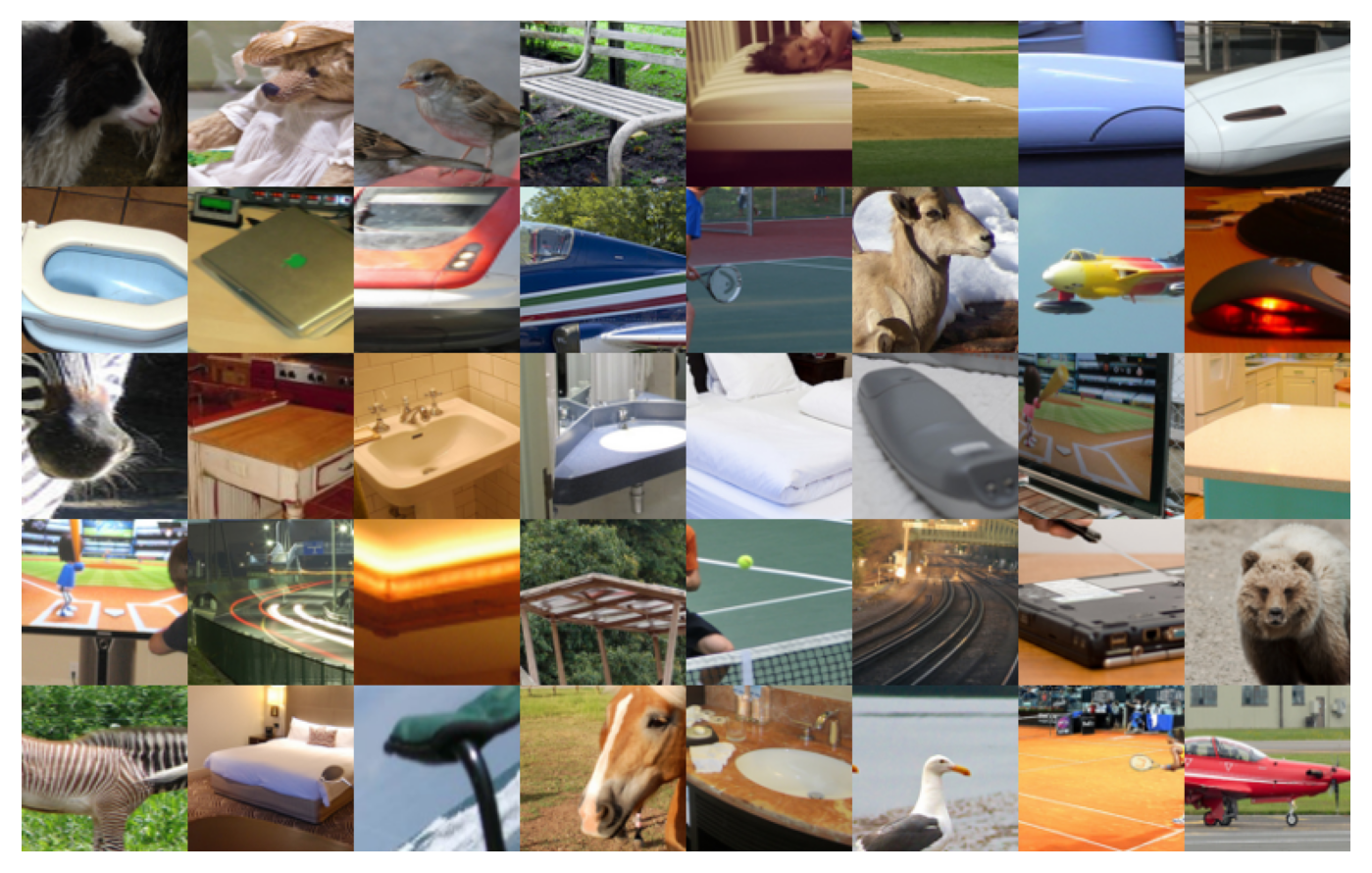
#| fig-cap: "The 40 strongest positive responses among COCO images that contain no cat, dog, car, truck or bus. The best of these reaches above the 99th percentile of all images."
rest = [i for i in order if not has(i, ["cat", "dog"] + vehicles)]
print(f"best 'neither' image: activation {mx[rest[0]]:.0f} vs overall top {mx[order[0]]:.0f} "
      f"and 99th percentile {np.percentile(mx, 99):.0f}")
from collections import Counter
print("most common labels in the top 60 of these:",
      Counter(l for i in rest[:60] for l in labels.get(ids[i], [])).most_common(10))
fig, ax = plt.subplots(figsize=(8, 5))
ax.imshow(sheet(rest, z["argmax_yx"])); ax.axis("off")
```
What drives the neuron when cats and cars are excluded: frontal animal faces (goat, bighorn
sheep, horse, zebra, bear, small birds), the noses of trains and aircraft, computer mice and
remote controls seen end-on, and scenes with strong converging perspective lines such as tennis
courts, baseball diamonds, railway tracks and bed corners. The essay's own examples of what the
V generalises to were fox faces, pool tables and bullet trains. The COCO list is the same kind
of thing: pointed fronts and converging lines. This is the strongest evidence on this page for
the "V, not OR(cat, car)" reading.
## The circuit: inputs and readers from the weights
The essay names specific neighbours. Because `mixed4e`'s 1×1 branch is a 1×1 convolution,
its weight matrix is directly the vector of votes each `mixed4d` channel casts for 4e:55, and
the `mixed5a` convolutions give the votes 4e:55 casts for each `mixed5a` channel.
```{python}
#| code-summary: "Rank the essay's named inputs and reader by weight"
w_in = model.mixed4e_1x1_pre_relu_conv.weight[CH, :, 0, 0].detach().cpu()
top = torch.argsort(-w_in)[:8]
print("strongest inputs from mixed4d  (channel, weight):", [(int(i), round(float(w_in[i]), 3)) for i in top])
for c, name in [(493, "fox snout"), (477, "wolf face"), (201, "van front")]:
    print(f"  essay's 4d:{c} ({name}): weight {float(w_in[c]):+.3f}, rank {int((w_in > w_in[c]).sum())+1} of 528")
w1 = model.mixed5a_1x1_pre_relu_conv.weight[:, CH, 0, 0].detach().cpu()
print("strongest readers in mixed5a 1x1 branch:", [(int(i), round(float(w1[i]), 3)) for i in torch.argsort(-w1)[:6]])
print(f"  essay's 5a:94 (V-shaped flames): weight {float(w1[94]):+.3f}, rank {int((w1 > w1[94]).sum())+1} of 256")
```
The essay's named input 4d:493 is the single strongest weight into the neuron, by a factor of
more than two over the next, and its named reader 5a:94 is the single strongest reader in that
branch. The other two named inputs are in the top fifteen of 528. These are raw weights rather
than data-weighted attributions, so the agreement is if anything stronger than the essay
needed. (We have not visualised 4d:493 or 5a:94 ourselves; the labels "fox snout" and
"V-shaped flames" are the essay's.)
::: {.beyond}
## A synthetic probe: does a bare V excite it?
If the neuron were a geometric V detector in the way an early-layer curve detector is a curve
detector, a line drawing of a V should drive it. We draw simple shapes on a grey background and
record the pre-ReLU maximum and minimum.
```{python}
#| code-summary: "Line-drawn shapes on grey"
from PIL import ImageDraw
feats = {}
hook = dict(model.named_modules())["mixed4e_1x1_pre_relu_conv"].register_forward_hook(
    lambda m, i, o: feats.__setitem__("x", o))
def canvas(): return Image.new("RGB", (224, 224), (128, 128, 128))
def shape(kind, size=90, width=10, angle=0.0, color=(0, 0, 0), cx=112, cy=112):
    im = canvas(); d = ImageDraw.Draw(im)
    if kind == "V":
        a = np.deg2rad(angle); half = np.deg2rad(35)
        apex = np.array([cx, cy]) + size*0.5*np.array([np.sin(a), np.cos(a)])
        for s in (+1, -1):
            end = apex - size*np.array([np.sin(a+s*half), np.cos(a+s*half)])
            d.line([tuple(apex), tuple(end)], fill=color, width=width)
    elif kind == "O": d.ellipse([cx-size/2, cy-size/2, cx+size/2, cy+size/2], outline=color, width=width)
    elif kind == "disc": d.ellipse([cx-size/2, cy-size/2, cx+size/2, cy+size/2], fill=color)
    elif kind == "square": d.rectangle([cx-size/2, cy-size/2, cx+size/2, cy+size/2], outline=color, width=width)
    elif kind == "X":
        d.line([(cx-size/2, cy-size/2), (cx+size/2, cy+size/2)], fill=color, width=width)
        d.line([(cx-size/2, cy+size/2), (cx+size/2, cy-size/2)], fill=color, width=width)
    elif kind == "triangle":
        d.polygon([(cx, cy+size/2), (cx-size/2, cy-size/2), (cx+size/2, cy-size/2)], outline=color, width=width)
    return im
@torch.no_grad()
def run(imgs):
    x = torch.stack([torch.from_numpy(np.asarray(im, dtype=np.float32) - 117).permute(2, 0, 1) for im in imgs]).to(DEV)
    model(x); fm = feats["x"][:, CH]
    return fm.flatten(1).max(1).values.cpu().numpy(), fm.flatten(1).min(1).values.cpu().numpy()
kinds = ["V", "triangle", "X", "square", "O", "disc", "blank"]
sizes, widths, colours = [60, 90, 120, 150], [6, 12], [(0, 0, 0), (255, 255, 255)]
print(f"{'shape':9s} {'mean max':>9s} {'mean min':>9s}    (over 4 sizes x 2 widths x 2 colours; photo scale: 99th pct max = {np.percentile(mx,99):.0f})")
for kind in kinds:
    imgs = [canvas() if kind == "blank" else shape(kind, s, w, color=c) for s in sizes for w in widths for c in colours]
    a, b = run(imgs); print(f"{kind:9s} {a.mean():9.0f} {b.mean():9.0f}")
hook.remove()
```
Two things come out. The round shapes (an outline O and a filled disc) give the most negative
responses of any stimulus, a good deal below a blank grey field, so "round pushes it negative"
survives even in line drawings. But a bare V does *not* excite the neuron much: its positive
response is about a tenth of what a real cat face produces and no larger than a square's.
Whatever "V" means for this neuron, it is a pattern inside high-level structure (a face, a car
front, a converging road) rather than a geometric primitive. The essay says as much in its
footnote: "generalization happens inside high-level patterns", and the V neuron "really does
take in cat circuitry". A mid-network neuron's inputs are already fairly abstract, so this is
not a surprise, but it is a limit on how literally to take the word "V".
:::
## Assessment
- **Confirmed on public weights:** the named inputs and reader are the strongest by weight;
the negative pole is round things; the positive pole extends beyond cats and cars to frontal
animal faces, vehicle noses and converging lines.
- **Supported but not proven:** that "pointed versus round" is the *right* one-line
description. It fits everything we saw, and it fits better than OR(cat, car), which cannot
explain the goats, trains and tennis courts. A line-drawn V alone is not enough, so the
description is of a high-level shape cue, not a contour.
- **Not addressed here:** the second half of the essay's section, the car-into-dogs circuit
and the "generalised pose neurons". That needs feature visualisation with and without the
bias toward natural paths, which is the subject of the next section.
::: {.beyond}
## Questions from the reading group
Raised in discussion on 22 October 2026. The answers are ours, not the essay's.
**Before the essay, was the idea that 4e:55 fired on both cats and cars because it was
helping encode those two features in superposition, with many other neurons firing too?**
Roughly yes, with a historical wrinkle. *Zoom In* (2020) described 4e:55 as responding to cat
faces, cat legs and car fronts, and offered superposition as a hypothesis for why: a network
that needs more features than it has neurons folds several into one, and a neuron that is
"OR(cat, car)" is the visible symptom. *Toy Models of Superposition* only made this precise
in 2022. Under the precise version a feature is a direction in activation space, and if the
car direction is not neuron-aligned it spans several neurons: 4e:55 carries a piece of "car"
and a piece of "cat", other neurons carry other pieces, and a downstream reader recovers "car"
by the linear combination that cancels the cat part. Interference is tolerable because cats
and cars rarely co-occur. The car-into-dogs circuit was read the same way, as the car being
stored across several dog neurons for later decoding.
The essay's rebuttal is aimed at the decoding step. If that were the mechanism, some
downstream weight pattern would have to read the cancelling combination. The essay says none
does: the readers of 4e:55 use it as one thing (its strongest reader is a V-shaped-flame
neuron, which we confirmed from the weights above), and the dog neurons the car writes into
are shared pose neurons feeding car specialists. "Nothing reads that combination" turns a
question about appearances into a question about weights.
**The neuron does not fire strongly for a literal drawn V. How should we make sense of the
"V-shape" label? Is it "V-shapes in objects"?**
Yes, and we would go a little further. A neuron at `mixed4e` is defined by its inputs, and
its strongest inputs are already part detectors: a fox snout, a wolf face, a van front. What
those share is a pointed, convergent frontal structure built from the textures and parts that
mid-level neurons respond to. A line drawing has the geometry but none of the parts, so it
drives none of the inputs and therefore barely drives the neuron. The essay's own footnote
says this: to see the shared pattern you have to visualise what the neuron's *inputs* have in
common, not the neuron on its own.
So "V" is a compression of "pointed convergent front, as it appears in natural objects". The
COCO result supports that compression, since goats, horses, train noses, aircraft and
converging court lines all drive it, which OR(cat, car) cannot explain. What the evidence does
not settle is whether "V" is a better label than "frontal pointed object". A sharper synthetic
test would use photographic crops of pointed things with no face, such as boat bows, roof
gables and arrowheads, rather than drawn lines.
:::
## Discussion questions
1. The neuron fires on cat faces far more strongly than on anything else in COCO. Is a neuron
whose top of the distribution is 85% cats, but whose tail is "pointed things", best
called a cat neuron, a V neuron, or something else? Does the answer depend on what reads
it?
2. The essay's recommended trick is to describe a neuron without nouns. Try it on the
negative-pole sheet above. Is "round" the only candidate?
3. How would one tell a "V-shape" neuron from a "frontal face or front of object" neuron?
What stimulus would separate them?